Team Building Escape Room Game: Five Ways to Run One
Choosing a team building escape room game comes down to your head count, your budget and the room you have.
Guide
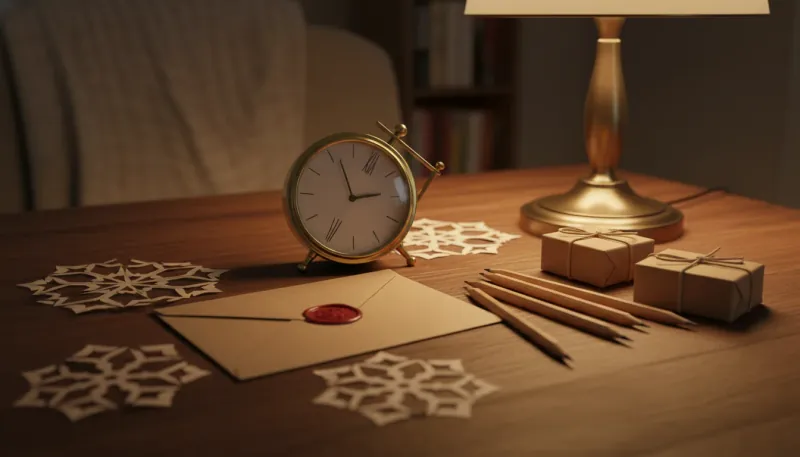
Planning one game for grandparents, parents and a six-year-old on Christmas Eve is a lot to ask. The best Christmas escape room ideas give every age its own job: the youngest hunt, the older kids solve, and the grandparents keep the family stories.
Write six short riddles on gift tags. Each riddle points to the place where the next tag hangs, and the last tag opens the game. The tree, the mantel and the coat rack all work. Keep riddles to one line so a new reader can solve one alone.
Prep takes about 15 minutes. The host's job is to hide the tags before guests arrive.
Cut out a dozen paper snowflakes and hide them at toddler eye level and at adult eye level. Small children who cannot read still carry real clues, so they feel part of the team. The American Academy of Pediatrics (opens in a new tab) says playing with both parents and peers is key to building thriving brains, bodies and social bonds. A hunt is the easiest way to play together across ages.
Draw the clue in white crayon on white paper, then brush over it with watery paint. Or use a sheet with a hole pattern and hold it up to a lamp. A light puzzle suits the dim lights of a Christmas evening. Use a phone torch or a lamp, never an open flame, near paper and decorations.
Print four old holiday photos, mix them up and ask the team to put them in order. A grandparent is the only person who can say which Christmas was which. This idea gives grandparents the role of expert, not spectator, and it takes no reading skill from the children.
Cut a family cookie recipe into steps and shuffle them. The team puts them back in order, and the finished recipe reveals the next clue. Counting and sequencing give older children a challenge, and a parent can check the order against the real recipe.
If you want the story, the clues and the hints already written, our Snowglobe Clock is built for this exact gathering. The story takes place inside a snow globe. A village clock stopped on Christmas Eve and four parts went missing. The players recover the parts, set the clock and open the tower doors on the wall to reveal Christmas morning.
Our game is for mixed ages from about 6 up, with 2 to 8 players and one adult host who does not play. The core puzzles are aimed at ages 8 and up. Younger players hunt for hidden snowflakes and gingerbread biscuits, match and count pictures, and open the tower doors at the end. The host guide gives three graded hints for every puzzle. Nothing is locked, so the host decides what the team earns. The game is designed for 45 to 60 minutes of play for about four players, with about 20 minutes of preparation after printing.
The table below shows who does what in the game.
| Player | Job in our Snowglobe Clock |
|---|---|
| Players aged 6 and up | Find hidden snowflakes and gingerbread biscuits, match and count pictures, color the toyshop blocks, hold the light at the pond, set the clock hands |
| Players aged 8 and up | Solve the core puzzles |
| Youngest player | Break the seal and open the tower doors on the wall |
| Adult host (does not play) | Read the letters, check every answer, hand over what the team earns and ring twelve chimes |
Whatever puzzles you pick, end with one reveal: a box, a taped-up paper door or a curtain that opens when the last answer is found. Give the opening to the youngest player. A shared finish is what children remember, and the adults get the photo.
A good family game gives the smallest player the last move.
Match each idea to the oldest and youngest person in the room. Mix two or three, because one puzzle type rarely suits everyone.
| Idea | Best for | Who leads | Prep |
|---|---|---|---|
| 1. Gift-tag riddle trail | Readers aged 7 and up | Older kids | About 15 minutes of hiding |
| 2. Hidden snowflake hunt | Players who cannot read yet | Youngest | Cutting and hiding |
| 3. Light-reveal message | A quiet table puzzle | Anyone | Crayon, paint or a lamp |
| 4. Family photo timeline | Grandparents and teens | Grandparents | Printing four photos |
| 5. Recipe in the wrong order | Ages 8 and up | Parents and older kids | Cutting a recipe |
| 6. Our Snowglobe Clock | Mixed ages, no writing needed | Host reads, team solves | Print, cut and tape |
| 7. Sealed box finale | Any group | Youngest | A box or taped paper |
Hold the game after the main meal, not before it. Hungry children rush puzzles, and a table full of food gets in the way of paper. The CDC says perishable food and cooked leftovers should go in the refrigerator within 2 hours (opens in a new tab), so clear the table and put the food away first. The cleared table then becomes the play space.
A printed kit is not the right answer in every case. If every guest is under six, the core puzzles will be too hard. The snowflake hunt or a simple gift-tag trail will serve you better. If you want an adults-only puzzle night, or you enjoy writing clues yourself, ideas 1 to 5 cost nothing but paper. Our Snowglobe Clock fits best when you want a full story with hints for a mixed-age family and no writing of your own.
Look for a story with jobs for every age. A good Christmas game has something to find for the youngest, puzzles to solve for older kids and adults, and a clear ending. The seven ideas above work that way, and our Snowglobe Clock is a ready-made Christmas family escape room for ages 6 and up.
A gift-tag riddle trail, a hunt for hidden snowflakes, a message that appears when you hold a page up to a lamp, a family photo timeline, a recipe with the steps out of order, and a sealed box that opens at the end. Each fits in one evening with paper, pencils and tape.
Start with one believable story, such as a stopped clock or a missing gift, then add three or four puzzles of different types so each player finds a job that suits them. End with one big reveal that the youngest player can trigger.
For Christmas, try a stopped village clock, a lost gift list, a locked recipe box or a toyshop that needs sorting. Choose a theme the grandparents can add stories to, because shared memories make the puzzles feel personal.
Pick two or three of these ideas, give each age one clear job, and start the game once the meal is cleared and the leftovers are in the fridge. The game works best when the youngest player gets the big moment at the end. If you would rather not write the clues yourself, our printable Christmas family escape room has the story, the puzzles and the host guide ready to print.
Keep reading
Team Building Escape Room Game: Five Ways to Run One
Choosing a team building escape room game comes down to your head count, your budget and the room you have.
Escape Room for Birthday: A Five-Step Party Guide
Planning a child's party is a lot, and the worry is a game that turns out too hard or too easy.
Escape Room for Teenage Party: A Five-Step Guide
Teens spot a babyish party fast, and a bored group of 14-year-olds makes for a long evening.