Escape Room for Teenage Party: A Five-Step Guide
Teens spot a babyish party fast, and a bored group of 14-year-olds makes for a long evening.
Guide
Planning a child's party is a lot, and the worry is a game that turns out too hard or too easy. An escape room for birthday guests at home needs one adult, a printed game and a plan for hiding the clues. It ends with the cake or the present.
An escape room for birthday guests is a party game where children solve clues together to open a locked box. At home, a printed game does the work of a venue. You print the pages, hide a few envelopes and read the opening aloud. The children solve, and the box opens on the present or the cake.
The American Academy of Pediatrics (opens in a new tab) says play can improve children's abilities to plan, organize, get along with others and regulate emotions. A birthday game puts that to work, and the steps below take you from the guest list to the last candle.
| Step | What to do | What to watch for |
|---|---|---|
| 1 | Pick the game by age and head count | The youngest child sets the level |
| 2 | Send the invitations and plan the timeline | Allow time for arrival, the game and the cake |
| 3 | Set up the room and the decorations | Hide the clues before guests arrive |
| 4 | Run the game | The adult hosts and does not play |
| 5 | Finish with the cake or the present | Party bags go out at the door |
Start with the youngest guest. A game made for 6 to 9 year olds is too easy for a 12 year old. A game made for 10 to 12 year olds is too hard for a 6 year old.
For ages 6 to 9, our Tumble and the Birthday Box takes 4 to 10 children. One adult host runs it and does not play. Four to six children play as one team. Seven to ten children play as two teams. Each team has its own copy of the team pages, and both teams open the same Birthday Box together. A 6 year old plays with an older child or an adult beside them.
For ages 10 to 12, our Midnight Skyport is set up for 3 to 5 players and an adult organizer. You print the game once per team. That fits a small group of 10 year olds, and a 12 year old sits at the top of its range. For a group of teens, look at our game for teens and adults.
Write the plan for the whole party, not just the game. Our game for 6 to 9 year olds is designed to run 30 to 45 minutes for one team. It has no timer and no way to lose. Our 10 to 12 game runs without a timer too, so leave a generous block in your plan.
Here is a sample timeline for a two-hour party at ages 6 to 9. Move the blocks to suit your house.
| Time | What happens |
|---|---|
| 0:00 | Guests arrive, get a crew badge, and see the locked Birthday Box |
| 0:15 | The host reads the opening aloud and hands over the first envelope |
| 0:20 | The game runs, about 30 to 45 minutes |
| 1:05 | The box opens on the present or the cake |
| 1:15 | Cake, singing and candles |
| 1:45 | Free play and party bags at the door |
Put the child's name on the invitation and the story page. Tell parents the party ends in the cake, so nobody arrives full.
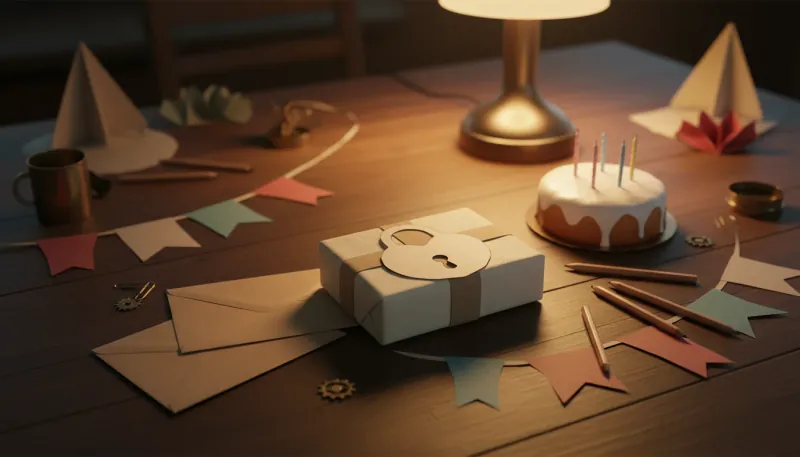
Decorations double as hiding places. Use balloons, a flag garland and kraft envelopes, and keep the locked box where everyone can see it from the start. The pack asks you to cut the photo page into 6 squares. Hide them in the party room, in easy view and low down, so the youngest children find them too.
Balloons need care. The Consumer Product Safety Commission (opens in a new tab) says to keep deflated balloons away from children younger than age 8. Pick up any popped pieces straight away.
You need scissors, tape, a pen, pencils and crayons in six colors. The children use child-safe scissors. Add three envelopes per team (or a folded sheet of paper) and a box or gift bag for the surprise. Prep after printing is designed to take at most 20 minutes for our 6 to 9 game.
Read the opening aloud, show the locked box and hand over Envelope A. The guests cut out the key, hunt for the photo pieces and rebuild the photo, which shows where Envelope B is hidden. Envelope B has three puzzles the team can split up. Envelope C asks them to count confetti.
You host and do not play. Hints come in three levels per step in the host guide, so you are never stuck without the answer. A child pushes the key into the paper padlock, and you check it against the answer key.
A good party game gives every child a job and lets the group finish together.
Not every guest will enjoy every puzzle. That is fine, because the puzzles can be split, so a child who dislikes cutting can count or match instead.
The ending is built for a surprise. The birthday crew opens the box, finds the Hooray card, and the party moves on to the present or the cake. If the cake is the surprise, put the Golden Cake Ticket in the box.
Party bags should match the story. Three or four small items are plenty: a pencil, a notepad, a certificate and a crew badge. Our pack has badges and certificates with a name line to print. HealthyChildren.org (opens in a new tab) notes that many choking incidents happen when older brothers or sisters give small objects to a younger child. Leave out tiny parts if little siblings are at home.
If you want the full pack, our printable birthday escape room for ages 6 to 9 costs $12.99. It is the wrong choice for a party of teens, or for more than 10 children at ages 6 to 9 in one room. It is also wrong for guests who want a real venue with a game master. For those parties, book a venue or pick the game for older ages.
Yes, if the game fits the ages. An at-home escape room keeps a group of children busy together, off screens, and ends with a clear moment such as opening a box or cutting the cake. Pick a game made for your children's age so the puzzles are neither too hard nor too easy.
Yes. Our Tumble and the Birthday Box is made for children aged 6 to 9, and every player page has one to three short instruction lines. The puzzles use pictures, colors, shapes, counting and matching. A 9 year old can lead a team.
It depends on the game. Our youngest game is for ages 6 to 9, built for early readers, and a 6 year old plays with an older child or an adult beside them. Every player page has a short Helper box for that person. Venue rooms set their own age rules, so ask before you book.
Yes, with a game that is made for 10 and up. Our Midnight Skyport is made for ages 10 to 12 and is set up for 3 to 5 players and an adult organizer.
Yes. Our Midnight Skyport covers ages 10 to 12, so a 12 year old sits at the top of its range. Guests who are 13 or older fit our game for teens and adults, The Halcyon Blackout.
Choose a game by the youngest guest, count the children, print the pages, and hide the clues before the guests arrive. Give the children badges, let them play for about 30 to 45 minutes, and keep the cake or the present for the end. The five steps above give the full order.
Three or four small items is plenty. A pencil, a notepad and a certificate cover the escape room theme. Skip small parts if younger siblings are around.
Fit them to the story: a pencil, a sheet of stickers, a certificate with the child's name and a crew badge. Both of our birthday-age games come with extra certificates and badges or credentials you can print for each guest.
Pick the game by the youngest child, count your guests, and print the pages a day ahead. Hide the clues, hand out the badges and let the children work it out together. Finish with the present or the cake, then send everyone home with a pencil and a certificate.
Keep reading
Escape Room for Teenage Party: A Five-Step Guide
Teens spot a babyish party fast, and a bored group of 14-year-olds makes for a long evening.
Escape Room Games for the Classroom: Seven Formats Compared
Class parties and fun Fridays go sideways when thirty students wait for one adult to run the show.
How to Give Escape Room Game Hints: A Three-Level Routine
Watching your players stare at the same clue for ten minutes is the part of hosting that worries most people.