Escape Room Games for the Classroom: Seven Formats Compared
Class parties and fun Fridays go sideways when thirty students wait for one adult to run the show.
Guide
Teens spot a babyish party fast, and a bored group of 14-year-olds makes for a long evening. The best escape room for teenage party guests is a real case with grown-up clues, one table to work at, and a host who stays out of the way.
You can run a teen escape room party in one evening with printed paper, a table and an adult who mostly stays out of the room. Five jobs cover it.
| Step | What to do | What to watch for |
|---|---|---|
| 1. Pick the case | Choose a mystery written for teens, not a children's game with a new label | Childish clues and cute characters read as babyish |
| 2. Fit the group | Match the game's age range and player count to your guest list | One set per team, and the youngest guest sets the age |
| 3. Set the room | Print, sort into envelopes, put out scissors and pencils | Print the day before, not on party night |
| 4. Run the case | Read the opening, hand over the first envelope, step back | Hover and the teens stop owning it |
| 5. Close the case | Open the sealed solution, read it aloud, then serve the cake | Keep the hints file face down until it is needed |
A good teen case has a real mystery, documents that look like documents, and clues that need thinking rather than guessing. Three things separate it from a kids' game.
The story is grown-up. A hotel theft in a storm beats a talking animal. The clues are evidence, such as statements, a floor plan and a cloakroom ticket. Rhymes belong to the children's games.
Age matters because teens watch each other. The American Academy of Pediatrics notes that early teens often feel as though they are always being judged by their peers (opens in a new tab). A game that looks made for little kids is a risk for the host's kid. A game with a serious case file gives the group something to be good at together.
A teen party works when the teens feel trusted with the case.
The CDC's parenting guidance says teens aged 15 to 17 spend less time with parents and more time with friends (opens in a new tab). That is why this plan is built around a group of friends at one table and a host in the background.
Start with the guest list, then check the age range on the game. Our line-up splits into two options for this crowd.
For guests 13 and up, our mystery escape room kit The Halcyon Blackout is written for teens and adults. It seats 2 to 8 players around one table. The case is set in a storm-bound hotel on the coast of Maine in 1962. Players answer three questions in turn, check each answer in a Detective's Ledger, and finish by opening a sealed envelope with the full solution. The puzzles include a torn note you cut and rebuild, a letter you fold, mirror writing, and a cipher wheel you cut out and pin together. The host can play too, because the answers are kept out of everything the host has to read.
For guests aged 10 to 12, our Midnight Skyport is the better fit. It is written for 3 to 5 players aged 10 to 12 plus an adult organizer.
| Youngest guest | Game that fits | Players |
|---|---|---|
| 13 or older | Our Halcyon Blackout, a mystery case for teens and adults | 2 to 8 per set |
| 10 to 12 | Our Midnight Skyport, an adventure for ages 10 to 12 | 3 to 5, plus an adult organizer |
Four to six players at one table usually keep everyone busy. Eight is the top for one set of the mystery game. Above that, print one set per team and seat the teams apart.
The AAP's teen-party guidance also gives a staffing number. It suggests 10 to 15 teens for each adult (opens in a new tab). A party of 12 can be two teams of six with one adult in the house. A party of 20 wants a second adult.
Check the printed age range on any kit you consider. If the page does not say 13 and up, treat the game as a kids' game.
Plan one evening, not a whole day. The mystery game is designed to run 60 to 90 minutes, roughly 20 to 30 minutes per envelope, so the case fits between snacks and cake.
Print the day before. Each envelope file prints single-sided at actual size on ordinary US Letter paper. Choose the color files or the low-ink files, which carry the same pages and puzzles. Label four envelopes A to D, print each file straight into its envelope, and seal D. Preparation is designed to take under 20 minutes after printing.
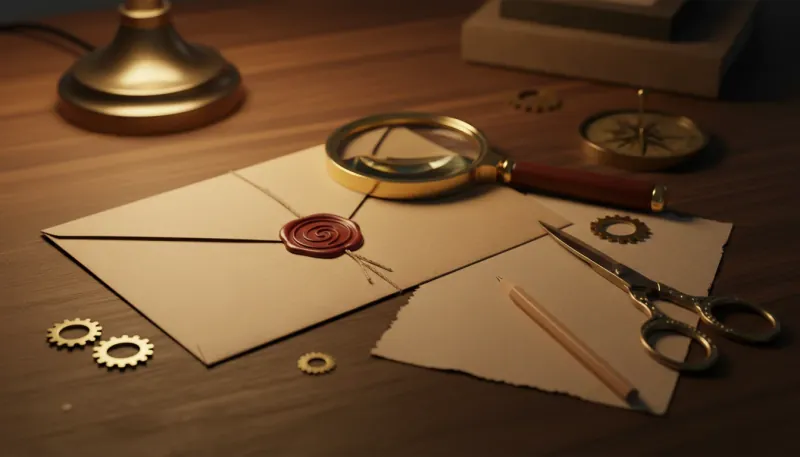
Do not cut anything in advance. Cutting the torn note and the cipher wheel is part of the play. Put out scissors, pencils, scrap paper and a sharp pencil or paper fastener for the wheel. One puzzle is read against a window or in a mirror, so leave a bright window or a hand mirror in reach.
Set the table with good light, enough elbow room and no phones on the case file. Those do more than any decoration. Keep the hints and answers file face down on a shelf.
A teen party evening runs in five blocks.
Read the short opening from the host guide, hand over Envelope A, and sit down somewhere else. That is the host's whole job for most of the evening.
Every envelope ends in one question. A correct answer in the Detective's Ledger tells the team to open the next envelope. The game itself tells the players what to do next. You do not need to referee or check their work.
The AAP's teen-party guidance says an adult should be present at all times. It suggests finding a spot where you can watch the party without getting in the way (opens in a new tab). The kitchen with the door open works. So does the next room with the lights on.
Hints come one at a time. The hints file gives two graded hints per puzzle, spread over three pages, and none of them gives the answer away. When a team has been stuck for a while, slide over the first hint page. If the team is still stuck, give the next one. Fewer hints leave more to be proud of, and you make the call.
Phones will come out. Put a bowl on the counter before the opening, and tell the guests the case is designed for 60 to 90 minutes. A stuck group often hunts for a distraction, and a hint is the better answer.
After the last Ledger check, the team writes its Accusation. Someone then opens the sealed Envelope D and reads it aloud. Envelope D explains what happened and how every clue fit, and it ends with a team rating, so the group gets a proper finish.
Serve the cake after the verdict. A birthday party for 13-year-olds does better with the food as the reward than as the start. Pizza grease and torn paper clues do not mix.
For a sleepover, run the case first and the movie after. Teens at night have a second wind, and a case designed for 60 to 90 minutes fits before it.
Our Halcyon Blackout is not for every teen party. The case is harder than our children's games, so a group of mostly 11- and 12-year-olds should start with a game made for their age. The game is played on paper around one table, so a group that wants a loud, moving party will find it too quiet. It works best with some readers in the group, because the clues are documents.
If you only want one fun hour with a crowd of 20 or more, a party game with more movement may be a better fit than any single case. Use the case when you want a small group to sit down and work something out together.
Plenty of hosts write their own clues, and a party can run fine on a few riddles and a locked box. A ready-made case saves you the writing and the answer key. Our Halcyon Blackout comes with graded hints for each puzzle, a ledger that checks every answer, and a sealed solution, so you can sit back as the host. It costs $12.99 for our mystery escape room kit for teens and adults, and you can print it for your own family or party.
Yes, when the game is written for their age. Our Midnight Skyport is made for ages 10 to 12, with 3 to 5 players and one adult organizer, and costs $12.99. Our Halcyon Blackout starts at 13 and is noticeably harder than our children's games, so a party with 12-year-olds is better served by the 10 to 12 game.
Print the clues, put each part in its own envelope, and seat the group at one table. For the mystery case in this guide, that means four envelopes labelled A to D, scissors, pencils, scrap paper, a sharp pencil or paper fastener, and a mirror or bright window. Keep the hints and answers file face down, read the short opening aloud, then step back.
Yes. Our Halcyon Blackout is written for teens 13 and up and adults. The crime is a theft, and the game has no violence and no gore. The puzzles are meant to be harder than a children's game, and every deduction rests on the printed material.
Yes, if the game is written for 13 and up. Our Halcyon Blackout is, and it gives two graded hints per puzzle in the hints file, so a stuck team can ask for help one step at a time. For a group that includes younger siblings, check the youngest guest's age first.
Choose the game by the youngest guest, count heads, and print one set per team. Allow one evening: snacks first, the case next, cake after the verdict. For a 13 year old's party, aim for a game that takes 60 to 90 minutes, which is what our Halcyon Blackout is designed for.
Yes. We give away a free 3-page sample with a puzzle, a decoder and a host page, so you can try the format before you buy a full game. Our full games, such as The Halcyon Blackout, cost $12.99 each.
A teen party escape room comes down to three choices. Pick a case written for 13 and up, seat the group at a table or two, and step back once you have read the opening. Print the envelopes the day before, keep the hints face down, and plan the cake for after the verdict. If you want a ready-made case, our mystery escape room kit The Halcyon Blackout is written for teens 13 and up, and the free sample shows you the format first.
Keep reading
Escape Room Games for the Classroom: Seven Formats Compared
Class parties and fun Fridays go sideways when thirty students wait for one adult to run the show.
How to Give Escape Room Game Hints: A Three-Level Routine
Watching your players stare at the same clue for ten minutes is the part of hosting that worries most people.
Escape Room Ideas: Seven Picks by Occasion
Picking a theme gets easier when you start with who is coming and how old they are.