Family Escape Room Game at Home: Seven Ways for All Ages
Getting grandparents, parents and a six-year-old around one table can feel like a puzzle of its own.
Guide
Planning the clues for a home game night is easy to get wrong, because one puzzle that is too hard stalls the whole group. Seven puzzle types cover most escape room puzzle ideas for home: cipher, logic grid, mirror writing, fold, cut and rebuild, hidden objects and locks. The list below gives an original example of each and the age it suits.
A cipher swaps each letter for another by a rule. The oldest well-known example comes from the Roman biographer Suetonius. He says Julius Caesar wrote private letters in a way that no single word could be made out (opens in a new tab), and that a reader substituted the fourth letter for the first, d for a.
An original example for a home game starts with a printed message and a taped strip showing the alphabet twice. Tell your players that every letter was moved three places forward. With that shift, BED is written EHG. Players slide the strip, test one word and keep going.
A shift cipher suits ages 8 and up, because it needs steady letter-by-letter work. For ages 6 to 9, use a picture code instead. Each picture stands for a letter, and the decoded word is only four letters long. For teens and adults, give your players a two-disc wheel to cut out and pin together, so they build the decoder themselves.
Make it easier by writing the shift number on a nearby page. Make it harder by hiding the shift inside a story clue.
A logic grid is a table where players cross out what cannot be true until one answer is left. It is the best puzzle for readers who like to think before they act.
Try three cousins, Ana, Ben and Cy, who each hid one thing: a key, a map or a coin. Clue one says Ana did not hide the key. Clue two says Ben hid neither the key nor the map. A 3 by 3 grid settles who hid what in under a minute.
A 3 by 3 grid works from about age 8. A 4 by 4 grid, with four people and four objects, suits ages 8 to 11 with a teammate beside them. Larger grids with six persons of interest suit teens and adults.
Keep every clue on one page so no one hunts for a missing statement. Put the grid on the same sheet as the clues, with a pencil beside it.
Mirror writing is text written backward so that it reads normally in a mirror. It makes a good clue because players can see a message but cannot read it. That is the feeling of a locked door.
Picture a note from a lighthouse keeper, written right to left. Players hold it to a hand mirror, a phone camera in selfie mode or a bright window. The note then tells them which drawer to open.
Young children often write some letters backward while they learn to write. A review in the Journal of Neurology, Neurosurgery, and Psychiatry (opens in a new tab) says this happens mainly between about 3 and 7 years old, and that the child often cannot read the mirrored form. Save mirror clues for confident readers, from about age 8, and keep the message short.
Print this clue on ordinary paper. Heavy card blocks the light when players read it against a window.
A fold puzzle hides half of its answer on one side of a crease. Players fold the page on a printed line, and two parts of the drawing meet.
Print a bookcase page with five moons in a row. When your players fold along the marked line, only one moon lines up with a gap on the other side. That moon is the answer.
Folds suit ages 6 and up because the action is simple and the result is visible. A younger player can do the folding while an older player reads the clue. For a harder version, ask players to fold the page twice in a set order.
Hold the page up to a lamp or window if the answer shows through the paper. Mark the crease with a dotted line and the words "fold here".
Players cut a printed page into pieces and put them back together. A torn note, six map tiles and a strip of parcels are all this type.
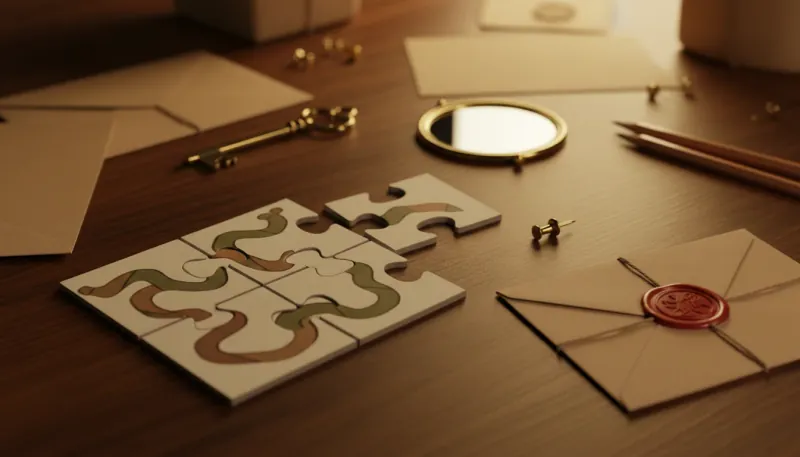
Cut six square tiles that make up a harbor map. Each tile has part of a path, and the path only runs through when the tiles sit in the right order. The finished map shows where the next envelope is.
Cutting along straight lines is fine from about age 6, with child-safe scissors. Leave pieces with curved edges to an adult. Most children remember this puzzle, because the finished picture is a clear reward.
Cut the pieces in front of the players only if time allows. Cutting before the game saves five minutes, but cutting during the game gives restless players something to do.
Hidden objects are paper cards, shapes or symbols placed around a room. Players find them and match each one to a slot on a sorting page.
Hide twelve paper stars at child height, each with a different shape on the back. Players find them, then match each shape to a space on a chart. A missing star means a missing shape, and the chart shows which one.
Hidden objects suit the widest age range, from about age 6, because finding needs no reading. Young players get a real job while older players decode. Hide cards at eye level for the youngest players and never on high shelves or in locked places.
Count the cards before the game and again after. A lost card is the usual reason a hidden-object puzzle stalls.
A lock puzzle turns the answers of earlier puzzles into one final action: opening a box, a padlock or a set of dials. You do not need a real lock. A paper padlock, a key cut from paper or a set of picture dials works as well.
Build a five-dial picture lock. Each dial has a set of pictures, and each dial's clue points back to a different earlier page, so the final answer needs every earlier result.
A paper lock with one answer suits ages 6 to 9. A multi-dial lock suits ages 8 and up. For teens and adults, a four-dial lock fed by a cipher feels like a real vault.
Put the lock last. Players should reach it with all the pieces in their hands, so the last minute is all about opening.
A good puzzle gives the player one clear thing to notice and one clear thing to do.
Pick puzzles by what the youngest player can do, then add harder types for everyone else. The first table below sorts the seven types by age, what players need and how long setup takes.
| Puzzle type | Suits ages | What players need | Setup |
|---|---|---|---|
| Cipher (shift or picture code) | 8 and up; picture code from 6 | Pencil, decoder strip | Print and place |
| Logic grid | 8 and up | Pencil | Print and place |
| Mirror writing | 8 and up | Hand mirror, phone camera or window | Print and place |
| Fold | 6 and up | Nothing | Mark the crease |
| Cut and rebuild | 6 and up with child-safe scissors | Scissors, tape | Print, pre-cut optional |
| Hidden objects | 6 and up | Nothing | Hide cards before play |
| Lock (paper padlock or dials) | 6 to 9 for one answer; 8 and up for dials | Pencil, small box | Build the lock |
If your group has mixed ages, give each player a puzzle type they like. A reader takes the cipher, a builder takes the tiles and the youngest takes the hidden cards.
Every puzzle type also stalls in its own way. The second table shows where players usually get stuck and the first hint to give, so you can write your hint cards before the game.
| Puzzle type | Where players usually stall | First hint to give |
|---|---|---|
| Cipher | Sliding the strip the wrong way | Say which direction the first letter moves |
| Logic grid | No clue to start from | Name the one clue that settles a single square |
| Mirror writing | Holding the page the wrong way around | Say where the light should come from |
| Fold | Folding on the wrong line | Point to the printed crease |
| Cut and rebuild | Two pieces seem to fit | Show which piece sits in the corner |
| Hidden objects | One card is missing | Name the empty space on the chart |
| Lock | One dial gives a wrong answer | Say which earlier page that dial points to |
Our seven games in the full collection of printable escape room games use these types in different mixes. Our classroom game for grades 3 to 5 has a simple letter-shift code and a 4 by 4 logic grid. Our Halloween and large-group games have mirror-writing clues. Our Midnight Skyport for ages 10 to 12 builds a folded beacon tower. Our mystery game for teens and adults has a cut-out cipher wheel that feeds a four-dial lock. Each game includes graded hints and an answer key for the host.
If you want to try one puzzle first, our free 3-page sample lives at the free printable escape room.
Build your own if you want a theme only your family knows, such as a puzzle hunt about your own house. The hints and the answer key are yours to write. Most props in the first table, such as pencils, tape, scissors and a hand mirror, are ordinary household items.
Count your time as the main cost. Our Christmas game is designed for about 20 minutes of preparation after printing, and our mystery game for under 20. A first homemade game will usually take longer.
A bought game is the wrong choice if you want a puzzle that only your family would solve, or if you want a game that plays on a screen. Our games are printed PDFs and nothing is online.
Buy a game if you want the puzzles already built, with graded hints for every puzzle (three levels in most games, two in the mystery game) and an answer key. A stuck group then never waits on you.
If a puzzle is too easy or too hard on the night, change the help and leave the puzzle alone. Give the next hint sooner to a group that is stuck, and hold hints back from a group that is racing ahead.
The seven used most in home games are the cipher, the logic grid, mirror writing, the fold, cut and rebuild, hidden objects and the lock. Each one has an original example and a suggested age in the list above.
Find the key first. It is usually a shift number, a decoder wheel or a picture-for-letter table. Apply it to one short word, check that a real word appears, then decode the rest of the message.
It depends on the age of the players and on how much help they get. No rule fixes the number, so plan by minutes. A rule of thumb is 8 to 10 minutes per puzzle, so a 60-minute evening holds four to six puzzles, and fewer for younger players. Our Christmas family game has six puzzles and is designed for 45 to 60 minutes. Our mystery game for teens and adults is designed for 60 to 90 minutes. Start with four puzzles and keep a spare one in the box.
Yes. Our free sample, The Missing Invitation, is a 3-page game with a puzzle, a decoder and a host page. You can get it at /free-printable-escape-room/.
Yes. Start with one of the seven types above, write the clue and the answer on the same card, and test it on one person before game night. A single cipher, tile puzzle and lock is enough for a first evening.
Give each clue one thing to notice and one thing to do. Hide the clue in plain sight, write the hint on a separate card, and make sure the answer to one puzzle is the starting point of the next.
Pick three types out of the seven. A cipher, a cut-and-rebuild puzzle and a lock make a complete evening, and each one asks something different of your players: reading, building and counting. Write down one hint per puzzle before the game starts, so a stuck player never waits while you think. Run the game once with a friend, fix the clue that confused them, and print the clean copy.
Keep reading
Family Escape Room Game at Home: Seven Ways for All Ages
Getting grandparents, parents and a six-year-old around one table can feel like a puzzle of its own.
Escape Room Party at Home for Adults: A Six-Step Guide
Hosting friends and wondering what to do after dinner?
Halloween Themed Escape Room: Six Ideas by Scare Level
Planning a Halloween party where some kids love spooky and others hide behind a sofa?