Escape Room Riddles With Answers: 12 for Every Age
You need clues in your hand before the guests arrive.
Guide
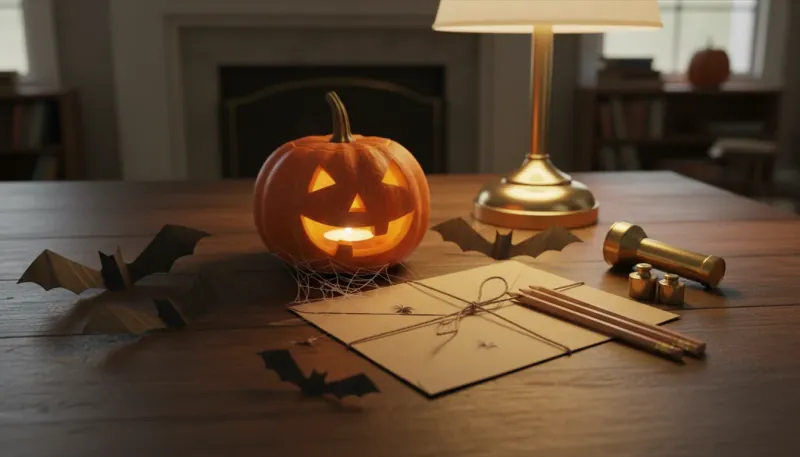
Planning a Halloween party where some kids love spooky and others hide behind a sofa? A Halloween themed escape room works best when you pick the scare level first, then the age, then the props you already own.
Pick the scare level, and the rest of the plan falls into place. Six ideas follow, from gentlest to spookiest, each with the age it suits and props you probably have in a cupboard.
Scare level matters because children differ. The American Academy of Pediatrics says on HealthyChildren.org (opens in a new tab) that scary movies can linger and cause nightmares, and that some kids are fine with spooky content while others do not enjoy it at all. A party game is not a movie, but the same sensible rule applies. Plan for the child who scares easily.
Scare level 1 of 4. Hide ten pumpkins or paper bats around one room and tape a picture clue to each. The trail ends at a treat bowl.
Grab lunch bags, a marker, orange paper and a bowl of treats. A grown-up reads each clue aloud, so nobody has to read. There are no codes and no timer.
Older kids will finish a pumpkin clue hunt in minutes. Use it for the youngest guests, or as a warm-up before a bigger game.
Scare level 1 to 2 of 4. A kind ghost has sealed a treat chest and hidden clues around the house. The kids find out why, relight his pumpkin and open the chest together.
Our Ghost of Pumpkin Hill is built this way. Its story is spooky-fun and never frightening, with no gore and no horror. The core players are 8 to 12, and younger siblings can help hunt bats, count and say the final words. It plays with 3 to 10 children, and from 6 players you split them into two teams.
You need a printer with US Letter paper, a box or bag of treats, scissors, tape, pencils and envelopes. A low-ink edition of the pages is included for printers that run low. Optional extras are a small mirror and a flashlight for the finale. Prep after printing is designed to take at most 20 minutes, and play is designed for about 45 to 60 minutes.
Scare level 2 of 4. A witch's potion has gone wrong and your players must put the right jars in the right order. Use spice jars or cups from the kitchen with paper labels.
Gather jars, masking tape, a wooden spoon and battery tea lights. Most of the props in this list cost nothing if they are already in your kitchen. Treats and paper are the only likely purchases. Write a short rhyme that gives the order, and keep every label in plain words. Do not use real ingredients that might cause an allergy.
Give the rhyme a test run by reading it to another adult before the party.
Scare level 2 of 4. A lockbox sits at the far end of a room strung with yarn cobwebs. Three paper puzzles each give one digit of the lock.
You need a lockbox or a suitcase padlock, yarn, painter's tape and a few clue cards. Keep the yarn at knee height, away from doorways, so nobody trips. Set up a clear path through the room.
Scare level 3 of 4. Lower the lights, add flashlights and play soft spooky sounds. Players search the room for clues without the overhead light.
Dark rooms are where nerves show up. The AAP's page on childhood fears (opens in a new tab) lists fear of the dark as a common childhood fear. Keep the lights on a dimmer, not off, and never leave a child alone in the dark room.
A good Halloween game lets every child decide how scary it gets.
For light, the U.S. Consumer Product Safety Commission advises battery-operated lights or glow sticks rather than an open-flame candle (opens in a new tab) in jack-o'-lanterns. It also says that open-flame candles belong away from curtains and decorations. Choose battery tea lights for every idea here.
Scare level 4 of 4. Teens often want a real chill. Use a dark hallway, a creaky door sound and a story about a house with a secret, then give the group a clear exit and a light switch.
Use flashlights, a sheet over a chair, a phone speaker and cobwebs. Tell the group before you start that anyone can step out at any time, and mean it. The HealthyChildren.org guidance reminds parents that older children may feel pressured to join in and that many adults do not enjoy scary things either.
A gentle kit is the wrong choice for 14-year-olds who came for a scare, because a friendly ghost story will feel too young. Our Ghost of Pumpkin Hill suits younger players.
Adults and children can share a party, and one grown-up should host. The host knows the answers and hands out hints, so an adult who wants to solve alongside the kids should leave the host role to someone else. The host guide for the Ghost of Pumpkin Hill gives three graded hints per puzzle. Offer only the first hint to confident 11 and 12 year olds, and go through all three for younger players. A bigger crowd of six or more splits into two teams.
A homemade game can use the same three-step hints. Write a nudge, a clearer clue and the answer for each puzzle, then give them in that order only when a group is stuck.
Tell the story first, in daylight, so no one meets a surprise. Say which room is the play room and where the light switch is. Put a calm job within reach of the youngest, such as holding the mirror or counting bats.
Four settings turn the scare level up or down for your group.
| What you control | Gentler | Spookier |
|---|---|---|
| Light | A lamp stays on | Flashlights in a dimmed room |
| Sound | None, or quiet music | Soft creaks and wind |
| Story | A friendly ghost who needs help | A house with a secret |
| Exit | Everyone stays together | Anyone can step out at any time |
The AAP's guidance on fears is plain. Do not belittle a child's fears in front of friends, and do not try to pressure a child into being brave. If someone wants out, let them sit with you and hold the answer sheet.
Start with your youngest guest and your lowest tolerance for scary, then look across the row.
| Idea | Scare level | Best ages | Players | Set up |
|---|---|---|---|---|
| 1. Pumpkin clue hunt | 1 of 4 | 4 to 7 | Any small group | Lunch bags and a marker |
| 2. Friendly ghost mystery | 1 to 2 of 4 | 8 to 12 | 3 to 10 | Printed packets and a treat box |
| 3. Witch's potion shelf | 2 of 4 | 8 and up | 3 to 8 | Jars, tape and a rhyme |
| 4. Cobweb vault | 2 of 4 | 9 and up | 3 to 8 | Lockbox, yarn and clue cards |
| 5. Dim-room haunted house | 3 of 4 | 11 and up | 3 to 8 | Flashlights and sounds |
| 6. Haunted mansion | 4 of 4 | Teens | 3 to 8 | Dark hallway and a story |
If you want the friendly-ghost option without building the puzzles yourself, a printed kit saves the work of testing every clue. Our Ghost of Pumpkin Hill includes a host guide, hints and an answer key, so you never have to guess a solution. You can print the pages as often as you need for your own family or party, but not resell or share the files. It also has party extras such as a door sign, invitations, certificates and name badges. If you want to build every puzzle yourself, ideas 1, 3 and 4 above give you a start.
Common ones are a haunted mansion, a mad scientist's lab, a cursed library and a graveyard at night. For a family party, keep the story friendly. A ghost who needs help, a witch whose potion went wrong or a pumpkin that lost its glow all feel spooky without being frightening.
Six that work at home are a pumpkin clue hunt, a friendly ghost mystery, a witch's potion shelf, a cobweb vault, a dim-room haunted house and a haunted mansion for teens. They are sorted by scare level above, so you can pick by your youngest guest.
Tie the puzzles to things in your own house. A recipe torn into pieces, a bookcase page that folds to show a hidden moon, or a message written in mirror writing all feel fresh because the kids use ordinary objects in a new way.
Try a pumpkin clue hunt. Tape one clue to each pumpkin or bucket, number them, and let the kids follow the trail to a treat bowl. It needs no cutting or codes and suits the youngest guests.
Good home-made puzzles are a mirror-writing note, a torn recipe to reassemble, a counting puzzle with hidden paper bats, and a matching puzzle with family portraits. Keep each one to a single idea, test it on another adult, and write down a hint for every puzzle.
Choose the scare level for your most sensitive child. Start with a story the kids can relate to, use lights you can switch on at any moment, and let anyone step out without a fuss. The six ideas above run from a pumpkin clue hunt to a dim-room haunted house, so there is one for most family parties.
Keep reading
Escape Room Riddles With Answers: 12 for Every Age
You need clues in your hand before the guests arrive.
Escape Room Date Night at Home: Set Up for Two
Dinner out gets old, and a booked room is not always an option on a weeknight.
Escape Room for Youth Group: Run It in 90 Minutes
Planning one meeting for twenty young people and a single leader is a lot to carry.