Escape Room Puzzle Ideas: Seven Types for Every Age
Planning the clues for a home game night is easy to get wrong, because one puzzle that is too hard stalls the whole group.
Guide
Picking a theme gets easier when you start with who is coming and how old they are. The best escape room ideas for home fit one occasion, one room and one evening, and the seven below come with the story, the space and the time each one needs.
Escape room ideas work best when they match your guests, not the other way around. A birthday for eight year olds, a Christmas dinner with grandparents and a Friday night with teenagers need different stories and different rooms. Below are seven picks, each with the story, the room it needs and the time it takes.
Playing together matters more than the theme. The American Academy of Pediatrics says that play is a buffer against the negative impacts of stress and builds the bond between parent and child (opens in a new tab). An evening of shared puzzles gives you that on purpose.
A good escape room at home has one goal, one story and one table everyone can reach.
Your party pup has locked the birthday box and hidden the clues all over the house. The children find the pieces of a torn photo, follow it to a hidden envelope and fill the circles on a paper key.
Your party room works, with a few easy hiding places low down. One team of four to six children needs a table and three envelopes. Seven to ten children play as two teams. The game is designed for 30 to 45 minutes with one team, plus up to 20 minutes of prep after printing.
Children aged 6 to 9 play our Tumble and the Birthday Box, where the surprise inside is a present or the cake. Six year olds join in with an older child or an adult beside them. There is no timer and no way to lose.
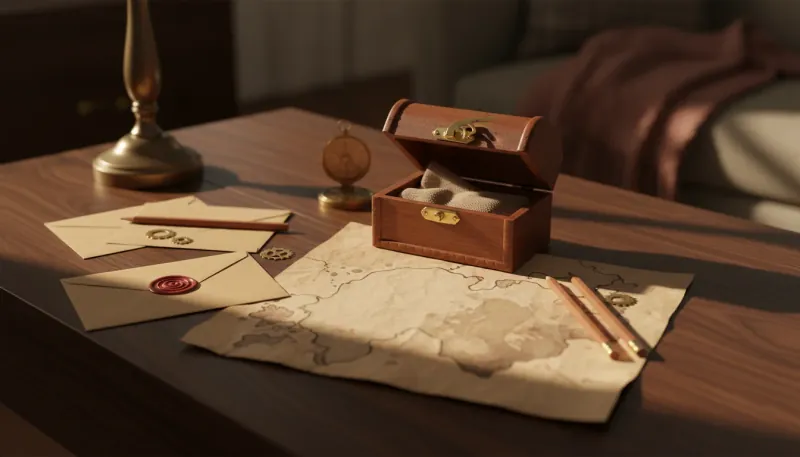
A pirate captain has torn up the treasure map and scattered the pieces. The crew finds each piece, lines them up and follows the route to a chest of treats.
Any room or a yard with several hiding places will do. A treasure hunt is the simplest kind of escape room, because each clue leads to the next place. Plan three to five stops. Fewer stops keep younger children from losing the thread.
We don't sell a pirate game. If you build this one yourself, copy what works in our games below: one clear goal, clues that point to places and a treat at the end. Write your hints on a card before the party so you aren't making them up while the children wait.
Fog has swallowed the landing lights at the airfield and the old beacon has gone silent. The night crew restores contact and brings the last ship home.
A team of three to five needs one big table, with space to build a small paper beacon tower and three hangar-door models. There is no timer, so you set the pace. Plan a relaxed evening.
In The Midnight Skyport, our game for ages 10 to 12, the crew opens each packet only after you check the result. An adult starts the internal window cuts.
Oswin, the ghost of Pumpkin Hill House, has sealed the treat chest and hidden his clues around the house. Halfway through, the children learn why he is lonely and relight his Great Pumpkin.
You need a house or a party room with places for eight hidden bat cards. A small mirror and a flashlight are optional. Three to ten players can join, in two teams from six players up. It is designed for 45 to 60 minutes, with up to 20 minutes of prep after printing.
Our game The Ghost of Pumpkin Hill is spooky-fun and never frightening, with no gore or horror. Core players are 8 to 12, and younger siblings can help hunt for bats or hold the mirror.
On Christmas Eve the great clock in a snow globe village stopped and four parts went missing. The family helps the clockmaker find them and wakes the clock.
Pick a room with a wall where you can tape the two-page poster that becomes the tower doors. Two to eight players join in one team, grandparents and children together. With about four players it is designed for 45 to 60 minutes, and the prep after printing is about 20 minutes. Two players take longer.
Our Snowglobe Clock gives younger players their own jobs, such as finding hidden snowflakes, counting pictures and setting the clock hands. The youngest player opens the tower doors at the end.
Long ago, someone buried a time capsule and split the way to it into parts. Teams solve their part, then the whole room opens the capsule together. The Library of Congress notes that time capsules do not have to be buried (opens in a new tab), so the idea works in a classroom, a church hall or a living room.
A big group of 8 to 24 players needs one table per team and a central table for the final map. A class needs desks, a board or a projector, and can run up to eight teams. The big-group game is designed for 45 to 60 minutes and the class game for 40 to 50 minutes, one class period.
Our two time capsule games use this idea. The Hundred-Year Capsule suits reunions, scouts, youth groups and big parties with mixed ages from about 10 to adult. The Time Capsule Case is for grades 3 to 5, with the finale on screen for the whole class.
A storm has cut off the Hotel Halcyon. The lights went out for nine minutes during the gala, and a sapphire brooch is gone. The players read statements, a floor plan and a torn note to find who did it.
The mystery needs one table for two to eight players, a mirror or a bright window, scissors and pencils. Play is designed for 60 to 90 minutes, roughly 20 to 30 minutes per envelope.
Teens 13 and up and adults play our Halcyon Blackout, from a game night with friends to a couple's date night. It is noticeably harder than the children's games, and the crime is a theft with no violence.
Start with the youngest player, then check the head count. Pick the room last, because most of these ideas fit a normal living room.
| Idea | Best for | Players | Room | Designed play time |
|---|---|---|---|---|
| 1. Birthday box | Ages 6 to 9 | 4 to 10 | Party room | 30 to 45 minutes |
| 2. Pirate treasure hunt | Ages 6 to 10 | Any | Room or yard | Your plan |
| 3. Night crew mission | Ages 10 to 12 | 3 to 5 per set | Big table | No timer |
| 4. Friendly ghost | Ages 8 to 12 | 3 to 10 | House | 45 to 60 minutes |
| 5. Stopped clock | Ages 6 and up | 2 to 8 | Room with a wall | 45 to 60 minutes |
| 6. Time capsule | Grades 3 to 5 or mixed groups | 8 to 24, or a class | Tables or desks | 40 to 60 minutes |
| 7. Hotel mystery | Ages 13 and up | 2 to 8 | One table | 60 to 90 minutes |
Here is the host's set-up for each idea after printing, before the guests arrive. Every row is about what happens after you print.
| Idea | Set-up after printing |
|---|---|
| 1. Birthday box | Up to 20 minutes, with Envelopes B and C hidden in two everyday places |
| 3. Night crew mission | Mount and close three hangar-door models, with an adult starting the window cuts |
| 4. Friendly ghost | Up to 20 minutes, including cutting the bat cards and key cards |
| 5. Stopped clock | About 20 minutes, with the poster taped to a wall |
| 6. Time capsule, big group | Under 25 minutes for four teams, including one read of the host guide |
| 6. Time capsule, class | 15 minutes or less |
| 7. Hotel mystery | Under 20 minutes, with four envelopes labeled A to D |
Want the puzzles, hints and answers for every row except the pirate hunt written for you? All 7 of our printable games come in one collection, and each game keeps its hints and answers for the host.
Most of the seven stories mix a few puzzle types. Here is where each type appears in our games, so you can match the puzzles to your players.
| Puzzle type | What players do | Where it appears |
|---|---|---|
| Cut and rebuild | Fit torn photo pieces, map tiles or a torn note back together | Our Birthday Box, Hundred-Year Capsule and Halcyon Blackout |
| Logic grids and deduction | Cross out options until one fits, or compare statements and alibis | Our Time Capsule Case, Hundred-Year Capsule and Halcyon Blackout |
| Codes and ciphers | Read a picture code, a letter-shift code or a cipher wheel the players cut out | Our Birthday Box, Time Capsule Case and Halcyon Blackout |
| Mirror writing | Read a note in a mirror or against a window | Our Ghost of Pumpkin Hill, Hundred-Year Capsule and Halcyon Blackout |
| Counting and matching pictures | Count confetti or match pictures, which suits early readers | Our Birthday Box and Snowglobe Clock |
| Hidden cards | Search the room for cards that carry clues or parts | Our Ghost of Pumpkin Hill and Snowglobe Clock |
| A final lock | Combine earlier results into a paper padlock or a printed dial lock | Our Birthday Box, Time Capsule Case and Halcyon Blackout |
A pirate hunt uses only the hidden-pieces idea. When you build it yourself, add one cut-and-rebuild step, such as the torn map, and keep every clue short.
Every game needs a printer, US Letter paper, scissors, pencils, tape and some envelopes or folded sheets. One adult hosts: that adult prints, cuts, hides the pieces and reads the host guide. Each game comes in a color edition and a low-ink edition with the same puzzles, so you can save ink. Player pages are single-sided at 100 percent.
Each purchase arrives by email as PDFs: the player pages, a host guide with three graded hints per puzzle and the answer key, and, in most games, optional party extras such as certificates. Our Halcyon Blackout keeps its two hints per puzzle and its answers in a separate file, so the host can play too. Our Midnight Skyport has progressive hints in its host book. Hints come one small step at a time, so you give just enough help and the players still solve the puzzle. You never solve the game first.
One game is $12.99, or all 7 are $49.99. You may print as many copies as you need for your own family, party or class. You may not resell or share the files. To check the format first, play the free three-page sample, The Missing Invitation.
If you want props, a locked door or actors, a printed game won't give you that. Our games use paper, scissors and envelopes. They also need an adult host who prints, cuts and reads the guide. If you have no time to prepare, or you want a room full of physical locks, pick a venue instead.
Print the game, put the pages in envelopes, hide the pieces and read the opening aloud. The players solve puzzles to get a code, a word or a piece for the next step, and you check their answers. Keep the hints and answer key for yourself, and give hints one small step at a time if the team gets stuck.
Pick a story that fits the occasion: a birthday box that someone locked, a pirate map in pieces, a friendly ghost, a stopped Christmas clock, a buried time capsule, a school class case file or a stolen brooch at a hotel. One clear goal beats a complicated plot.
Tear a treasure map into pieces and hide them around the house. Every piece found unlocks a clue, and the last clue leads to a chest of treats. Cut the map into as many pieces as you have players, so everybody finds one.
A time capsule works well for a class: students solve case files to find where the capsule is buried, then open it together. Any story with a clear goal and teams of three to five students will do.
The best escape room ideas start with your guests, not the theme. Pick the occasion, check the ages, choose a room with a table and a few places to hide things, and keep the story to one sentence. If you want the puzzles, hints and answers already written, the printable games in the collection cover each occasion on this list except the pirate party.
Keep reading
Escape Room Puzzle Ideas: Seven Types for Every Age
Planning the clues for a home game night is easy to get wrong, because one puzzle that is too hard stalls the whole group.
Family Escape Room Game at Home: Seven Ways for All Ages
Getting grandparents, parents and a six-year-old around one table can feel like a puzzle of its own.
Escape Room Party at Home for Adults: A Six-Step Guide
Hosting friends and wondering what to do after dinner?