Escape Room Kits for Large Groups: A Five-Step Guide
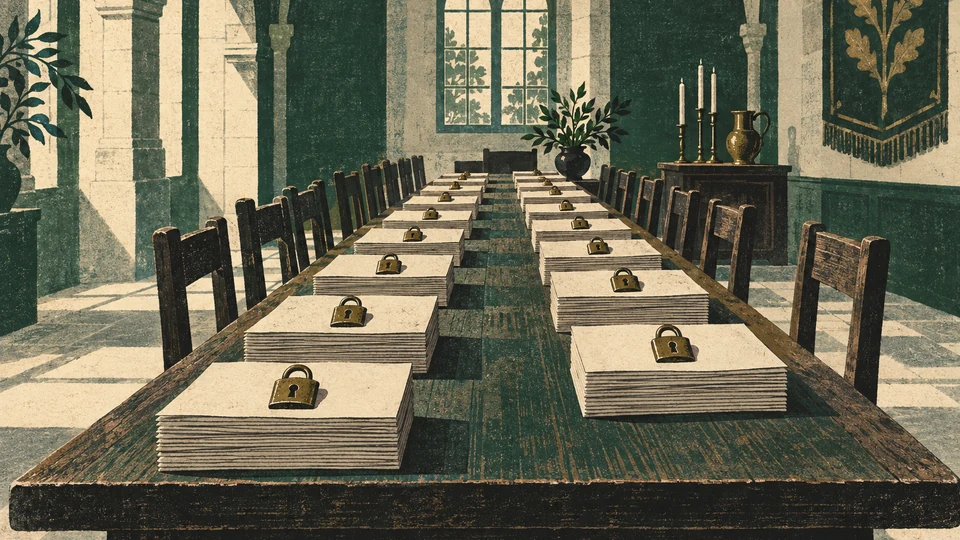
Twenty guests and one printable game can sound like a bad match. Escape room kits for large groups work because you split the room into tables of four to six. You print one set of the same game for each table. The five steps below take you from the head count to the last lock.
Step 1: Count your group and split it into tables
Start with the head count. Split your group into tables of four to six. That's how many people can work on one set of clues without anyone just watching. Twelve guests make three tables, twenty make five, and thirty make six.
Escape Game Kit's 2026 market study looked at 677 reviews of printable escape room kits in September 2026, and about one in five describes playing in a group, team or class. Big groups are common for these kits, so you're not the first host to split a room.
Trainers see the same table sizes at work. The Association of Public Health Laboratories runs escape rooms for staff and recommends teams of three to five people (team-building guide).
| Group size | Tables | Printed sets | Pages to print for a 12-page kit |
|---|---|---|---|
| 12 | 3 of 4 | 3 | 36 |
| 20 | 5 of 4 | 5 | 60 |
| 30 | 6 of 5 | 6 | 72 |
| 40 | 8 of 5 | 8 | 96 |
Step 2: Pick one kit by your youngest player
Every team plays the same story, so you only choose once. Look at the youngest person in the room and pick a kit whose cover fits that age. Say you have a family reunion of 24, aged 8 to 70. You'd set up six tables and choose a kit rated 8 and up, because your youngest player is 8.
4 of Escape Game Kit's 10 kits are written for small teams rather than a single table of 1 to 8: Detective for a Day, Footsteps of Faith, The Storykeeper's Library and The Christmas Mix-Up. Those four are the easiest to run in a hall. Detective for a Day is written for small teams aged 10 and up. It has no fixed clock, so each team finishes in its own time. You can compare them with all ten kits and choose by age.
Step 3: Print one set per table
Print the whole PDF once for each table. Clip each set together and write the table number on the first page. If two more guests show up, you print one more set.
Schools run escape games for whole classes the same way. An Erasmus+ guide for teachers describes using several boxes at once. The class is split into small teams that play at the same time (Erasmus+ guide).
Step 4: Brief the room once and start together
Read the story aloud once, to everyone. Then let every team open its first envelope at the same moment. A team that starts late finishes late, and you'll hear about it.
Give each team its own table. One table per group is all the space a team needs, so a hall, a classroom or a big living room all work. Leave enough room between tables that teams can't overhear each other.
Keep your tables small even if the room is big. A neuroscience course that ran an escape room for its students capped each group at four and allowed six at most (the study). With four to six, everyone has something in their hands.
A large group plays one story best as several small tables.
Step 5: Walk the tables with the answer key
Keep the answer key with you and keep it face down. When a team gets stuck, give the hint first and the answer only if they ask again. Every kit comes with an answer key and hints for when a team gets stuck, so you can look after six tables without spoiling the game for any of them.
Plan the whole session at about an hour and a half. 6 of Escape Game Kit's 10 kits are written for 45 to 60 minutes of play; one runs up to 90. Add up to 25 minutes before your guests arrive if your kit needs cutting, and ten minutes for the briefing. Beyond the printouts, every table needs pencils, plus scissors and tape if your kit needs cutting.
Overview of the five steps
| Step | What you do | What to watch for |
|---|---|---|
| 1 | Split the group into tables of four to six | At a table of eight, two people only watch |
| 2 | Pick one kit by your youngest player | The age on the cover decides |
| 3 | Print one set per table | Go print-only for six tables or more |
| 4 | Brief everyone once and start together | A team that starts late finishes late |
| 5 | Walk the tables with the answer key | Hint first, answer second |
A printable kit isn't right for every big group. Some groups want to stand in one room together and share a single story. A venue can do that with connected rooms and a game master. With a kit, your 20 guests sit at five tables and each team plays on its own. If being together matters most to your group, book the venue.
Questions and answers
How many people can play one kit?
One printed set seats 1 to 8 players on most kits; two kits are written for 2 to 6 or 1 to 4, and four run as small teams. For a bigger room, print a second set: the PDF can be printed any number of times.
Does a kit work in a classroom?
Print one set per team and give each team a corner. Detective for a Day and The Storykeeper's Library run in small teams and fit inside a lesson; the teacher keeps the answer key.
How long does setup take?
Up to 25 minutes of cutting and placing for six of our ten kits; the other four are print only, so setup is the printing itself. Read the answer key once before the players arrive.
Which kit fits which age?
The age on the cover is the youngest player it works for. Four of our ten kits are rated 8 and up, three are rated 9 or 10 and up, and three are rated 12 and up. Pick by the youngest person at the table; older players take the harder codes.
Does it need a color printer?
No. The puzzles work in black and white, so a normal home printer will do. Color printing is recommended for the artwork.
What if we get stuck?
Every kit includes hints and an answer key for the host. Give a hint first; the answer is for keeping the evening moving.
Conclusion
Count your group, pick one kit by your youngest player, and print one set per table. Brief the room once, then walk between the tables with the answer key. The same PDF works for 12 people or for 30. The only thing that grows is the printing.
Sources
- Journal of Undergraduate Neuroscience Education via PubMed Central, a neuroscience escape room for student groups (2025) · last checked September 18, 2026
- Association of Public Health Laboratories, team-building guide: escape room (2021) · last checked September 17, 2026
- European Commission Erasmus+, Escape Games for Education and Beyond (2020) · last checked September 18, 2026