2 Player Escape Room: Four Printable Games for Home
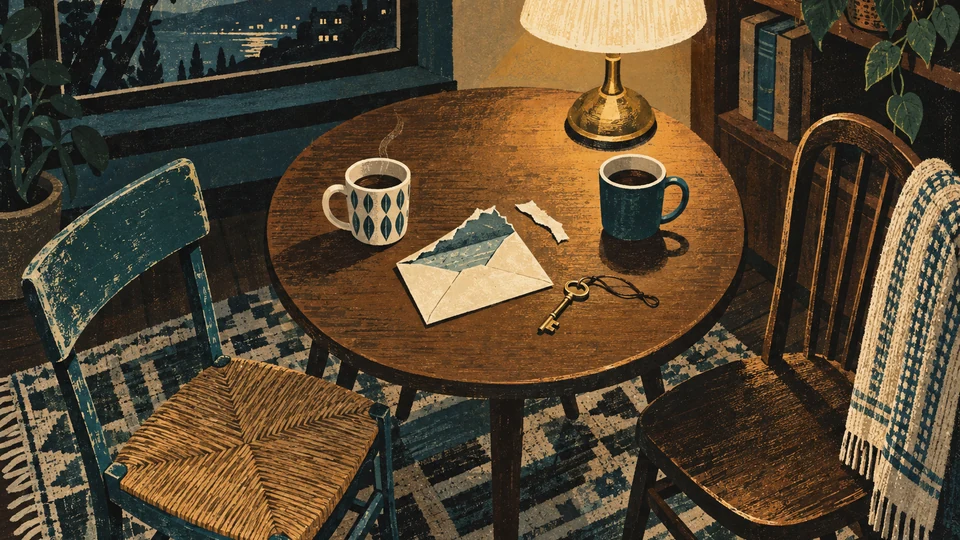
You've got a free evening and there are just two of you. A 2 player escape room works well at home if you split every puzzle into two jobs, one person reading and one solving. Two of our ten kits are written with a pair in mind, and the rest work if you give them more time.
Which of our kits are written for two players?
Two of the ten Escape Game Kit kits have a cover that fits a pair. Two more work well if you don't mind a longer evening. Every cover gives you a range of players, so look at the play time first.
| Kit | Players on the cover | Ages | Play time | Setup | Why it suits two |
|---|---|---|---|---|---|
| The Unsolved Case | 2 to 6 | 12 and up | 60 to 90 min | Print only | Written for a small table, with witness accounts you can read to each other |
| The Road to Bethlehem | 1 to 4 | 8 and up | 45 to 60 min | 15 to 25 min | A short clue path you can finish in one sitting |
| The Manor's Secret | 1 to 8 | 12 and up | 45 to 60 min | 15 to 25 min | Works for two, but expect the full hour |
| Footsteps of Faith | Small teams | 12 and up | 30 to 60 min | Print only | The shortest of the four |
Escape Game Kit's 2026 market study looked at 1,034 printable escape room kits in September 2026, and about one in five says how many players the game is for. Check the player count before you buy any printable game, because most sellers don't tell you.
For a date night, The Unsolved Case is the closest fit. You compare witness accounts to find a missing time capsule, it takes 60 to 90 minutes, and there's nothing to cut.
What do you need to play at home?
You need very little. Print the kit and grab two pencils. Most kits also need scissors and tape for the cutting. The Unsolved Case doesn't, because nothing in it has to be cut. One table is all the space the two of you need, and a kitchen table is fine.
How do two players split the work?
One of you reads and one of you solves. The reader holds the sheet, reads the clue aloud and keeps the answer key face down. The solver writes, counts or sorts the cards. After each puzzle, you swap. Puzzles you can talk through suit a pair best. In The Unsolved Case you compare witness accounts and test timelines, which works well when one of you reads and the other takes notes.
Read every clue twice before you touch the cards. In a bigger group, someone usually spots the link between a clue and its puzzle. With two, nobody else is there to catch it. A design course at the Czech Technical University in Prague tells its students to make clues clearly connected to their puzzles (design notes). Good kits follow that rule, and a second read does the rest.
How long does a two-player kit take?
Plan for the top of the time range on the cover. 6 of Escape Game Kit's 10 kits are written for 45 to 60 minutes of play; one runs up to 90. With two players you solve one puzzle after another, while a group of six works on three at once. The puzzles don't get harder. They just take you longer.
| Table | Typical run for a 45 to 60 minute kit | What changes |
|---|---|---|
| Two players | 55 to 75 minutes | You solve one puzzle at a time and read more aloud |
| Four players | 45 to 60 minutes | Two pairs work on two puzzles at once |
| Six to eight players | 40 to 55 minutes | Three pairs, and someone has to watch the order of envelopes |
Venues see the same thing. Scott Nicholson surveyed escape room venues in 2015 and found an average team of 4.58 people (facilities survey). As a pair, you're half a team working through the same number of puzzles.
Two players don't need fewer puzzles. They need a longer evening.
Do many people play escape rooms as a pair?
Yes, plenty do. In a 2018 survey of escape room fans, 16 percent said they usually play with just their partner (enthusiast survey). Venues told Nicholson that 11 percent of their groups are couples on a date (State of Escape). You're in good company.
When is a printable kit the wrong pick for two?
Skip the kit if you want the feel of a venue. You won't get a locked door, a game master's voice or a room built around the story. You get a story and a chain of puzzles, and the room is your kitchen. A kit also won't work if one of you doesn't want to read aloud, because the game needs both voices. In that case, book a room for two.
Questions and answers
How many people can play one kit?
One printed set seats 1 to 8 players on most kits; two kits are written for 2 to 6 or 1 to 4, and four run as small teams. For a bigger room, print a second set: the PDF can be printed any number of times.
How long does setup take?
Up to 25 minutes of cutting and placing for six of our ten kits; the other four are print only, so setup is the printing itself. Read the answer key once before the players arrive.
What if we get stuck?
Every kit includes hints and an answer key for the host. Give a hint first; the answer is for keeping the evening moving.
Can I print it again for another group?
Yes. Your PDF download can be printed any number of times, for a second table this evening or another group next year.
Which kit fits which age?
The age on the cover is the youngest player it works for. Four of our ten kits are rated 8 and up, three are rated 9 or 10 and up, and three are rated 12 and up. Pick by the youngest person at the table; older players take the harder codes.
Does it need a color printer?
No. The puzzles work in black and white, so a normal home printer will do. Color printing is recommended for the artwork.
Conclusion
You can play any of the ten kits with two people. Expect a longer evening, because you solve one puzzle at a time. Pick The Unsolved Case or The Road to Bethlehem, swap reader and solver at every envelope, and keep the answer key face down.
Sources
- The Codex, 2018 escape room enthusiast survey (2018) · last checked September 18, 2026
- Scott Nicholson, State of Escape: escape room design and facilities survey (2016) · last checked September 17, 2026
- Scott Nicholson, Peeking behind the locked door: a survey of escape room facilities (2015) · last checked September 18, 2026
- Czech Technical University in Prague, escape room design lecture notes (2026) · last checked September 17, 2026